

MARFAM WEEKLY E-NEWSLETTER 28 JANUARY 2026
On this day which would have been our 59th wedding anniversary I’m offering some personal reflections from the coal face. After 47 years of ministry to marriage and family life and 26 years of widowhood my spirituality nevertheless remains based on God’s presence in marriage and family life, at every stage.

The Catholic church was a late starter in the country and has been active for a little over 200 years. The Southern African Catholic Bishops Conference has been active since it was established in 1947, but its leadership was granted hierarchical status in 1951, as opposed to being a missionary church with vicariates and prefectures ruled mainly from outside. What does that mean in practice? In 1951 archdioceses and dioceses with bishops as local shepherds of the People of God were formally established. Some bishops were local priests and others from outside the country. The SACBC now includes South Africa (8%), Swaziland (6%) and Botswana (4%) as the number of Catholics (an outdated figure but still fairly accurate) This 75 year anniversary is what is celebrated at this time and will continue during the course of the year.
“The Catholic Church in Southern Africa marked a historic milestone on Sunday with the opening Mass of the Jubilee Year celebrating the 75th Anniversary of the Establishment of the Ecclesiastical Hierarchy, held at the Church of the Beatitudes in Zwavelpoort, Pretoria East.” View on https://youtu.be/kTE-czoZHoQ and visit the SACBC website for details. Cardinal Stephen Brislin, president of the SACBC preached the homily. He spoke about the difficult realities of the past, especially political, but spoke too of the new challenges of our time.
Facing new challenges with a call to repentance. “Turning to the present, Cardinal Brislin warned that while apartheid has passed, new evils now threaten human dignity and life. Corruption, lawlessness, violence, poverty, and the breakdown of infrastructure continue to burden society. Echoing the Gospel proclamation, he insisted that the Church must never cease to call the world to conversion: ‘“Repent, for the kingdom of heaven is close at hand.”’
Repentance, he explained, means a return to ethical living, to truth, justice, peace, service, and respect for human dignity. It also demands renewed attention to family life, which he described as the “first Church” and the primary place of evangelisation, moral formation, and prayer.”

This area of family life is my main focus in these ”thoughts from the coal face” with a particular focus on the relationship with the hierarchy, from my own experience and perspective and reading through some historical resources. Where and how did this relationship begin and operate?
If we take the 1962-5 Vatican II documents, Gaudium et Spes as a starting point contains a lengthy section on the Sacrament of Marriage. Lumen Gentium introduced the concept of the family as the domestic church. These passages on church life do not feature in the history of the Church in SA until very much later.
Although my late husband Chris and I had been educated in Catholic schools our religious formation had been “the usual,” focusing on the catechism, the creed, commandments, sacraments one of which of course was marriage. However our marriage preparation pre-1967 consisted of some sessions with our parish priest Fr Tony Kelly. Like Chris’ parents we were active in our parish, catechetics and choir and church music, but no particular focus existed on our family life. In 1978 during a catechetical course I was introduced to Marriage Encounter as an “excellent experience” for any couple. As we heard, something we deserved, not that we needed. Well, I believe, we did both need and deserve it, because once I had persuaded Chris – as an anniversary present – to attend one of the very first weekends held in Johannesburg life for us changed, forever. Our relationship revived, but integrating the theology and spirituality was one of the most powerful experiences we wished to share. On our Catholic Engaged Encounter weekends – a programme we were able to start in JHB and SA – we shared that our relationship with the Church had changed from seeing ourselves as employees to being active share-holders. That vision of an involved laity, which was also rooted in Vatican II, has become my guiding vision not only for my church life but my life overall. In those early CEE years I do not remember an active involvement with the hierarchy. ME and CEE operated with the leadership form of couple and priest, and our discernment about these programmes tended to be with the programme leaders in the US. It is my perception – rightly or wrongly – that possibly one of the reasons why ME as a movement has diminished greatly in most parts of SA since the 1990s is because it was not fully mainstreamed and promoted throughout the country. Catechetics is compulsory but what about family life formation? Some bishops have experienced, and valued, an ME weekend and at least one is still active, but for most priests it started almost more as a side-line interest.
In my St Augustine’s MPHIL research paper I ask “Is marriage a neglected sacrament?” After more than 12 years since ME Chris and I and some of our CEE priests had begun to dialogue about the need for a wider family ministry. 1994 was declared by the UN as the INTERNATIONAL YEAR OF THE FAMILY. The SA Government Department of Social Development picked it up. Pope St John Paul II also picked it up and wrote a beautiful letter to the wider Church and instituted the 1st World Meeting of Families. Fr Emil Blaser – an ME priest – and Associate Secretary General at the SACBC at that time, organized for a Pastoral letter on IYF from the SACBC and also arranged for us to participate in WMF as we were on our way to the US for a CEE International meeting. That is how and when MARFAM was born, in Johannesburg in 1994, under the Department of Evangelisation with Fr Barney McAleer. At the time we were not aware that the 1st African Synod of bishops in 1994 had chosen the image of THE CHURCH AS THE FAMILY OF GOD for Africa, using the image of the African family as a model for the Church in Africa, which has become a core focus for my ministry and vision.
Our first contact with Bishop Orsmond in Johannesburg was inviting him to write a supporting letter for the 1st 3 yearly Marriage Awareness Campaign which had been suggested by SECAM after the 1994 African Synod. The wheels turned slowly and MARFAM grew little by little as a part of a network of other movements which had a family aspect, like Schoenstatt and Focolare. Tragically for me Chris died very suddenly in June 2000, leaving me to carry on, with some support, but more or less alone and with little financial help. Although not much appeared to be happening at hierarchical level the 2000 SACBC Pastoral Forum, in its discernment process chose 3 priorities, FAMILY LIFE, YOUTH and ONGOING ADULT FORMATION. Bishop Mvemve who headed the Evangelisation department was tasked to set up a Family Life Desk at SACBC level. That is how I, Toni Rowland, became coordinator of the SACBC Family Life Desk in due course, although finances there too were a difficulty. Some funding was obtained at times over the years but during my 12 years from 2003 to 2015, both at the SACBC and in the various dioceses. where family desks should have been established, finances were invariably a limitation.

The SACBC Family Life Desk and MARFAM adopted the vision of Vatican II and the 1994 African Synod. The Parish Family Ministry programme which was developed for use in dioceses and parishes had as its theme CHURCH AS FAMILY – FAMILY AS CHURCH. Bishop Eddie Adams took on responsibility for the Desk and we worked very well together while he was also very supportive of his diocesan Family Life Desk in Oudtshoorn.
During my years at SACBC I interacted with almost all the bishops of the region at different levels and different times, some mainly at meetings while others in their dioceses. Marriage preparation was the aspect most commonly recognized as essential, some bishops did take a greater interest in family life more widely and many had other interests and concerns e.g. evangelization, vocations, catechetics, justice and peace, youth, inculturation and family life was more of an extra. Post 1994 apartheid did not feature as strongly as it had before but many issues did come up over time and tended to be addressed almost in isolation, e.g. HIV/AIDS, gender based violence. After I retired from the SACBC I continued with MARFAM, through publications, now mainly digital, to promote an inherent family focus in church life general, also for specific areas of marriage and family life and more recently Becoming Eco-friendly families.
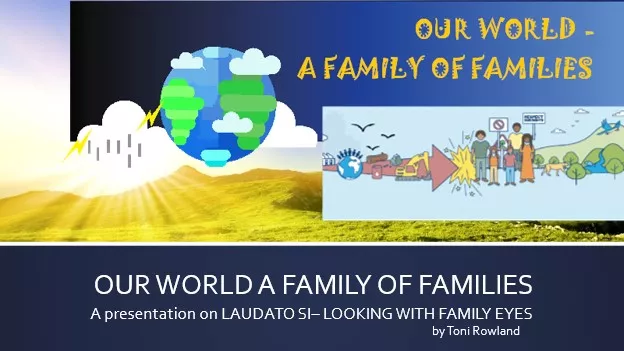
It is my contention that marriage and family life remain a very important aspect of church life but are inadequately resourced and promoted. It is where the laity – who are 99.9% of the Church, live their faith on a daily basis in their intimate relationships with one another and with God. While particular areas e.g. marriage preparation, enrichment, sexuality, widowed support and parenting can and should be supported through specific programmes the overall family focus is largely neglected. The vision and a spirituality of the Church as a Family, as a model and icon of the Trinity and even OUR WORLD AS A FAMILY OF FAMILIES which has been MARFAM’s vision for the last 5 years is – for me – sadly ignored. I study and research and produce, what I would like to think, are thought-provoking daily reflections. incorporating recent writings from Pope Francis and now also Pope Leo. I communicate with all the bishops, am more friendly with some, but in general, whenever I pop around once a year with my MARFAM FAMILY YEAR PLANNERS they all greet me with warm smiles and appear happy to see this perennial gogo whose mission appears to be never-ending, but maybe they do see me as the ”mad prophet” which is how I have begun to describe and even see myself.
There are many more personal anecdotes and contacts. Bishop Lobinger, of Aliwal, Lumko and Pastoral Cycle fame, told me to use and write stories of life experience in order to teach. I do write a lot. Archbishop William Slattery has always been a great supporter especially in his years heading Pretoria archdiocese and Evangelisation. We held Pastoral forums for which Fr Barney McAleer was responsible while I contributed the family focus aspect. A good number of bishops invited me and our team to conduct Parish Family Ministry training which was always well received, but almost never fully implemented, except where a really dedicated lay volunteer took the apostolate to heart.

Do I love and/or respect our bishops? I admit that some I do but many nowadays I hardly know. I’m well aware that they have a complex and difficult task, but while I’m not a promoter of women’s ordination I do believe that laity and family people could contribute much to leadership especially in these times of synodality, of listening and sharing from the heart. If that is not the essence and the domain of family life what is? I was delighted late last year when the SACBC issued a statement calling for a family-centred approach to gbv, which the government had declared as a national crisis. Who knows but maybe when I celebrate our 60th wedding anniversary we all will have shared and heard one another more under the guidance of Pope Leo who has begun well by saying “God will ask you what you have done for your brothers and sisters.” Laudato Si Raising Hope conference October 2025.

TR Family Weekly 28 January 2026
THOUGHT FOR THE DAY. 28 JANUARY 2026
28 January. SEE: At the first parent’s meeting in the parish one could sense the concern. “We are told that the youth are the future of the church but are we able to raise our own children as committed to their faith and as church-goers who will continue to build up the parish after us?” Some felt depressed but others expressed hope. “Some parishes in the diocese are doing something for the youth, but what are they offering?” “I saw that two new churches have been built in our diocese this year and that also tells us something. But we still need to work for family faith development in our homes, as that is our first little church, while we always need to pray, “Lord have mercy on our children. Fill them with your love.”
JUDGE, reflect and share: Scripture: The Lord spoke to Nathan the prophet.” I will raise up your offspring after you, and I will establish his kingdom. He shall build a house for my name.” from 2 Samuel 7:4-17. Pope Leo: Spiritual conversion, the intensity of the love of God and neighbor, zeal for justice and peace, the Gospel meaning of the poor and of poverty, are required of everyone, and especially of pastors and those in positions of responsibility. The concern for the purity of the faith demands giving the answer of effective witness in the service of one’s neighbor, the poor and the oppressed in particular, in an integral theological fashion.” DT 98
ACT: Decide on possible appropriate action. Conclude with prayer


Recent Comments