

MARFAM FAMILY MATTERS WEEKLY E-NEWSLETTER 12 AUGUST 2026
When I chose the topic for this newsletter and also for my FAMILY MATTERS radio broadcast on Radio Veritas on this day I had in mind to reflect on David Attenborough’s book THE TRIALS OF LIFE which features the varieties in the life cycle of animals, from birth to death, the who, whats and hows, as the August theme is Sexuality, a Family Gift. However, many other interesting topics got in the way and the animals stories will wait for the Season of Creation starting in September.

South Africa’s Women’s Day was celebraed on 9 August as the 70th anniversary of the historical Women’s March of 1956. This year the focus was on the excessive degree of abuse of women and children, i.e. the gender based violence which is a recognised national disaster. However again, Sophie du Bruyn, the last of the four leaders from the four different race groups in SA, who had led the 20 000 women who participated in 1956 was a guest speaker at the gathering hosted by President Ramaphosa. Her important statement struck a chord with me as being particularly relevant. She spoke of how the women marched without fear, but with determination and courage to confront the brutal apartheid government. She concluded, ‘Let the spirit of 1956 rise again.’ https://www.sanews.gov.za/south-africa/let-spirit-1956-rise-again-struggle-stalwart-sophie-de-bruyn Why did those words strike me, apart from the very memorable words that have become legendary, ” you strike a woman, you strike a rock.” Could I rather facetiously comment on that in context of today, by saying, “you asked for it:”
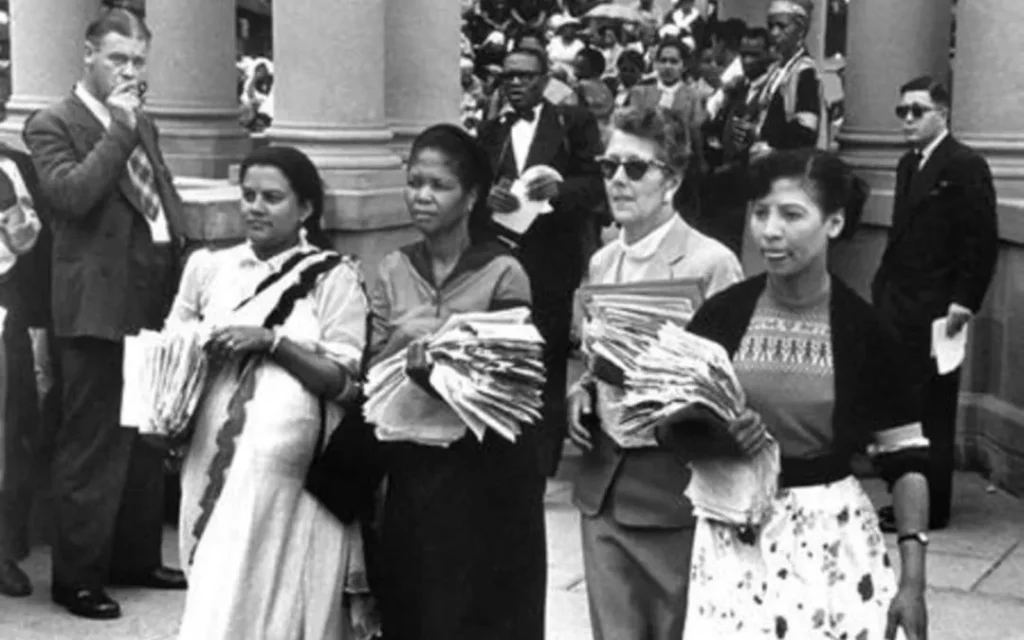
I do acknowledge the very important political aspects, but I personally responded to how she described the manner in which the march occurred. It had been very well planned and organized – by women leaders from the four racial groups in SA, in their roles as trade union representatives. The march – as she commented later – , was not a protest march in our 2026 sense, where a spirit of intolerance in making their demands, is accompanied by toi-toing, unruliness, chanting freedom songs and likely some violence and looting, 1956 was “illegal” but peaceful, dignified, disciplined, with no violence. The women had raised the money themselves and had come from all over the country. They came with babies on their backs. They stood in silence for 30 mins and were respectful of the authorities. Their justified cause was restrictions on the freedom of the people for the people being forced to carry passbooks. . Still today this has been considered one of the most significant protest events in the history of our country.

What strikes me is that protests today can be a very different matter. People do have the freedom and right to protest on any issue they choose, but protests are too often an excuse for scoring political points and some kind of rabble-rousing. Like the March and March undocumented migrants issue last June, that undoubtedly was important and had rights on its side, but has nevertheless ed to a great deal of unnecessary and irresponsible hardship and suffering for foreigners.
What strikes me too. The reflection on Women’s Day called Women on the Move that was posted on https://www.sanir.org/news?article=EGrjJy6SgDZhc3PlgC6w forwarded to me by the author, Claude Marie Bernard. Sharing this link and parts of the reflection show how deeply it struck me. Yes, women are victims, but they are also victors and, thanks be to God, visionaries. TR 12 august 2026
WOMEN ON THE MOVE.
A Women’s Day 2026 Reflection by the Southern Africa Network for Immigrants and Refugees (SANIR)
Women’s Day is a time to celebrate the courage, resilience, leadership and contribution of women. It is also a time to ask whether every woman is able to experience the freedom, dignity, safety and equality that this day represents.
For women on the move—mothers, wives, sisters and daughters who have crossed borders in search of safety, family, opportunity and a better future—Women’s Day carries a deeper meaning.
Their journeys are often journeys of courage. But they can also be journeys marked by uncertainty, documentation challenges, family separation, discrimination and xenophobic violence.
This Women’s Day, the Southern Africa Network for Immigrants and Refugees (SANIR) calls attention to the experiences of these women and reminds society that migration status must never become a justification for denying human dignity.
Behind every document is a human being,
For many migrant and refugee women, documentation is not simply an administrative matter. It is closely connected to their ability to live safely and participate fully in society.
For a mother, these difficulties can directly affect her children. For a wife, they can threaten family stability. For a sister, they can make her more vulnerable to exploitation and abuse. For a daughter, they can create uncertainty about her future and her sense of belonging.
An administrative failure can therefore become a human crisis.
And for women who are already vulnerable, documentation problems can make it more difficult to report violence, seek justice or approach authorities for assistance.
Mothers carrying more than children
Among the women on the move are mothers who carry far more than children. They carry the responsibility of keeping families together. They carry the emotional burden of displacement. They carry memories of conflict, persecution, poverty or separation. They carry the responsibility of finding food, shelter, education and healthcare for their families. And they carry hope.
Many migrant and refugee mothers have demonstrated extraordinary resilience in South Africa. They have established small businesses, found employment, supported other families, participated in community organisations and contributed to the local economy. Yet too often, their contribution is overlooked because public discussions about migration focus primarily on numbers, borders and immigration status.
Behind those statistics are mothers who wake up every morning asking a simple question: “How will I keep my children safe today?”
Wives trying to keep families together
A wife whose immigration status is uncertain may live with the fear of losing her home, employment or ability to remain with her family. Where documentation problems affect several members of a household, the consequences can multiply. Families may be unable to open bank accounts, secure employment, access accommodation or complete important administrative processes. In some circumstances, family members can find themselves with different legal or documentation statuses, creating additional uncertainty and stress.
Every family deserves a fair opportunity to live together in safety and dignity.
Sisters who become protectors
Sisters on the move often become invisible pillars of their families and communities. They care for children. They support elderly relatives. They provide emotional and financial support. They help other women navigate unfamiliar systems. They accompany vulnerable people to hospitals, police stations, government offices and community organisations. Some become interpreters, community volunteers, activists and human rights defenders.
Yet the same women who provide support to others may themselves be exposed to discrimination, exploitation and violence.
Daughters growing up between worlds
Perhaps one of the most important groups in this conversation is the daughters of migrants and refugees. Some were born in South Africa. Others arrived as young children. They attend South African schools, speak local languages, build friendships and participate in their communities.
South Africa is the only home some of them know. Yet documentation challenges can leave them questioning where they belong. A child should not have to carry the burden of an adult’s immigration history.
When documentation problems meet xenophobia
A woman who is attacked because she is perceived to be a foreigner experiences more than physical or verbal violence. She may lose her livelihood, her home, her sense of security and her trust in the community around her.
Xenophobia does not only hurt migrants and refugees. It damages the social fabric of South Africa. And it weakens the principle that every person deserves protection from violence.
Women on the move are not merely vulnerable
They are human rights defenders. While SANIR recognises the serious challenges facing migrant and refugee women, it is equally important not to define them only through vulnerability.
Women on the move are also leaders. They are entrepreneurs. They are teachers. They are health workers. They are caregivers. They are students and researchers. They are community organisers. They are peacebuilders. They are contributing to South African society every day.
What must change?
SANIR believes that protecting women on the move requires more than celebrating them once a year. It requires action.
First, documentation systems must work.
Second, women and children must receive particular protection where documentation challenges increase their vulnerability.
Third, xenophobic violence must be confronted decisively.
Fourth, families must be protected from unnecessary separation.
Fifth, women on the move must have meaningful opportunities to participate in decisions affecting their lives.
From celebration to solidarity
Women’s Day reminds South Africa of the historic struggle for women’s rights and equality. Today, that struggle must include women whose journeys have taken them across borders. This Women’s Day, SANIR therefore calls on government institutions, civil society organisations, communities
and ordinary citizens to look beyond immigration documents and see the human being behind them.
A woman is more than her immigration status. She is a human being deserving of dignity and protection.
A message to women on the move
To every mother who continues to provide for her children despite uncertainty: We see your courage.
To every wife working to keep her family together: Your family matters.
To every sister supporting others while facing her own struggles: Your contribution matters.
To every daughter growing up between borders, cultures and identities: You belong. Your dreams matter. Your future matters.
SANIR stands with women on the move—not only on Women’s Day, but every day.
This Women’s Day, let us move from celebration to solidarity.
Let us move from sympathy to action. And let us build a society where no mother, wife, sister or daughter on the move is left behind.
Southern Africa Network for Immigrants and Refugees (SANIR)
Advocating for dignity, documentation, protection, inclusion and social cohesion. Women’s Day 2026 | South Africa

THOUGHT FOR THE DAY 12 AUGUST.
August 12. SEE. Sibling relationships. The family and the youth groups presented insights into sibling relationships too. Thandi said, “Think of your own families. Is there rivalry between brothers or sisters and brothers, or jealousy, or resentment or possibly even sexual abuse or serious conflict for one or other reason? The intimacy in family units is unique among all other human relationships and should be cherished rather than abused.” Claire said “I personally admire the poor young people, who manage their own child-headed homes, but I also know that they do need more help than they get. It is not fair on teenage boys and girls to be responsible for younger siblings when they themselves have hardly developed their own personal identity. Sometimes they are just left behind in a different town, alone or with a carer or relative. These little units are very vulnerable on many fronts. Do we know of any?”
JUDGE. Reflect, share, act. Scripture: If your brother sins against you, go and tell him his faults between you and him alone. If he listens to you, you have gained your brother. But if he does not listen take one or two others along with you that every word may be confirmed by the evidence of two or three witnesses. Matthew 18: 15-20. Pope Francis Growing up with brothers and sisters makes for a beautiful experience of caring for and helping one another. We see the care and love that surround a little brother or sister who is frail or disabled. Children do need to be patiently taught to treat one another as brothers and sisters. This can be quite demanding and is a true school of socialisation. AL 195. Pope Leo:. Authentic realism does not give up on changing the world; indeed, it starts by clearly identifying interests, fears, constraints and power dynamics, precisely in order to determine what can be achieved, and the measures needed to achieve it. MH 218.
ACT AND PRAY. Reflect and share as appropriate, remember siblings and the needs of child-headed families. Pray St Francis Peace Prayer and pray: Mary, Queen Assumed into Heaven, Patroness of South Africa, pray for us.





Recent Comments